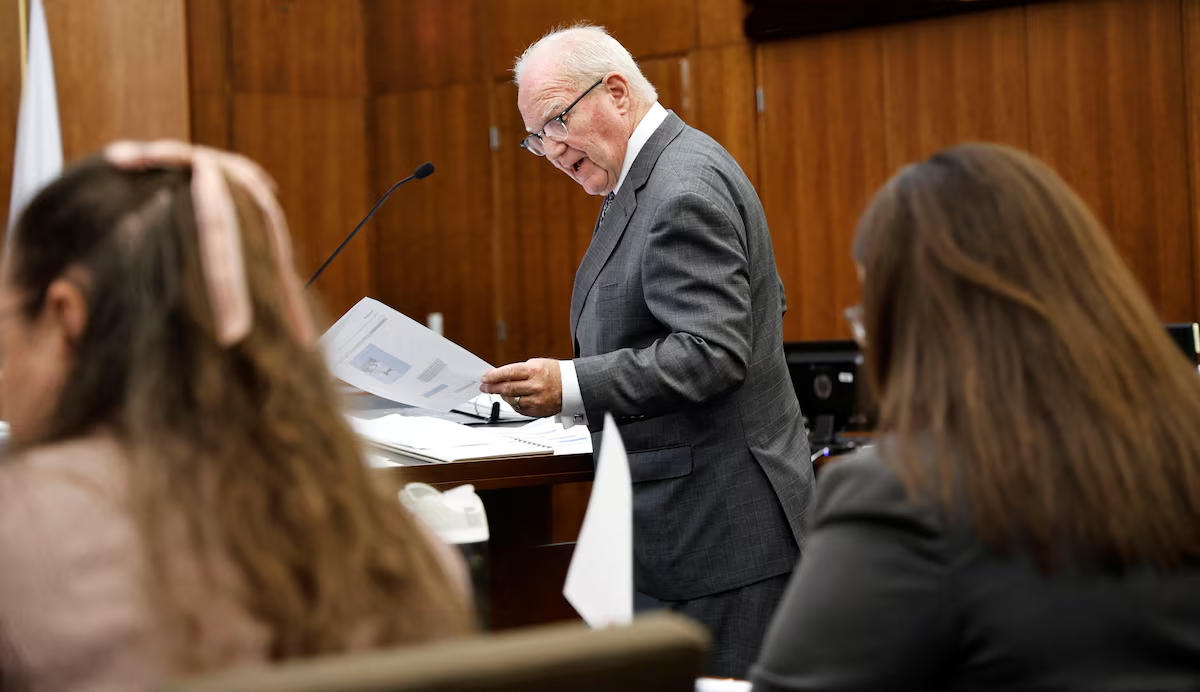
LAS VEGAS — August 17, 2026 — For almost 30 years, the killing of Tupac Shakur has existed between documented events and unanswered questions. On Monday, that uncertainty entered a courtroom.
Duane “Keffe D” Davis, the only person formally charged in connection with Shakur’s 1996 killing, went on trial in Las Vegas as prosecutors presented their account of what they say happened before the fatal shooting.
Davis, 63, has pleaded not guilty to a murder charge. Prosecutors allege that he helped organize the attack on Shakur following a confrontation earlier that night involving Davis’ nephew, Orlando Anderson, at the MGM Grand. Davis is not accused of being the person who fired the fatal shots.
That distinction is central to the case.
The prosecution is attempting to establish Davis’ responsibility for the killing through an alleged role in planning and facilitating the attack, rather than by proving that he personally pulled the trigger. Authorities have not established in court who fired the shots that killed Shakur.
The Night That Changed the Case
Shakur was shot on September 7, 1996, while riding in a BMW with Marion “Suge” Knight after attending the Mike Tyson fight in Las Vegas.
The rapper was struck multiple times and died six days later at the age of 25.
For years, no one was charged in the killing.
The investigation eventually moved in a new direction after Davis began speaking publicly about his alleged knowledge of the shooting. Prosecutors are now relying in part on statements he made over the years, including material contained in his 2019 memoir, Compton Street Legend.
But the fact that Davis discussed the killing publicly does not, by itself, establish the prosecution’s case. His defense is challenging the reliability and interpretation of those statements and arguing that the state’s account should not be accepted simply because Davis previously spoke about the events.
A Witness Remembers Shakur’s Final Conversation
The opening day also brought the jury testimony from former Las Vegas Metropolitan Police officer Garry Dale.
Dale described his interaction with Shakur after the shooting. According to testimony reported from the courtroom, Dale tried to get the wounded rapper to identify the person who had shot him.
Shakur did not provide a name.
Dale testified that Shakur responded, “No, we’ll take care of it.”
The exchange does not identify the shooter and should not be treated as proof of who carried out the attack. Its significance is instead that it provides testimony about Shakur’s condition and his response to investigators immediately after he was wounded.
It is one of the few surviving accounts from the period immediately following the shooting that is now being examined directly by a jury.
Prosecutors Present a Retaliation Theory
The prosecution says the shooting was an act of retaliation.
According to prosecutors, a confrontation at the MGM Grand earlier that evening involved Shakur and members of his entourage attacking Anderson. Prosecutors argue that the incident set in motion the events that culminated in the shooting.
They allege that Davis played a coordinating role and helped make the weapon available for the attack. Prosecutors have described him as a central figure in the alleged effort.
Those claims remain allegations.
The jury must decide whether the evidence establishes Davis’ criminal responsibility beyond a reasonable doubt.
The Defense Says the Story Is Not That Simple
Davis’ defense has offered a sharply different interpretation.
Attorneys for Davis have questioned the prosecution’s reliance on his past statements and argued that his accounts should not automatically be treated as reliable admissions of criminal responsibility. The defense has also challenged the strength of the evidence and the investigative history surrounding the case.
That creates the central conflict of the trial.
Prosecutors are asking jurors to view Davis’ statements and the surrounding evidence as pieces of a coherent account of the killing.
The defense is asking them to question whether those pieces actually prove what prosecutors say they prove.
Why the Passage of Time Matters
The trial arrives nearly three decades after Shakur was killed.
That delay has consequences.
Many people connected to the events of September 1996 are no longer alive, leaving investigators and attorneys to rely on surviving witnesses, historical records, prior statements and other evidence.
The passage of time also means the case has accumulated an enormous amount of public speculation. For years, theories about Shakur’s death have circulated through music culture, documentaries, books, interviews and social media.
A criminal courtroom operates under a different standard.
A theory does not become evidence simply because it has been repeated for years.
A public statement is not automatically a confession.
And an allegation is not a conviction.
Those distinctions will matter as testimony continues.
The Question Before the Jury
The trial does not require jurors to resolve every mystery surrounding Tupac Shakur’s death.
Their task is narrower.
They must determine whether prosecutors have proved that Davis is criminally responsible for the murder charge against him.
That is particularly important because Davis is not accused of personally firing the weapon. Prosecutors’ case instead depends on establishing his alleged role in facilitating and organizing the attack under Nevada law.
The proceedings are expected to include testimony from numerous witnesses connected to the investigation and Shakur’s final night. Marion “Suge” Knight, who survived the shooting, is among the people whose potential involvement in the proceedings has drawn attention.
For RaptureStone, the significance of the trial is not simply that one of the most famous unsolved killings in music has finally reached a jury.
It is that, after years of speculation, the story is now being subjected to the one standard that matters most in a criminal case: evidence tested in court.
Tupac Shakur’s death has remained a defining unanswered question in music history since 1996.
Now the questions surrounding that night are no longer being argued only in public.
They are being placed before a jury.
RaptureStone Editorial Desk
RaptureStone distinguishes established facts from allegations and testimony. Duane “Keffe D” Davis has pleaded not guilty and is presumed innocent unless proven guilty in court.